AC vs DC charging: which one do you actually need?
Two kinds of charging doing two completely different jobs. Which one belongs at your house, which one belongs on the motorway, and why the bigger number is not always the one you want.
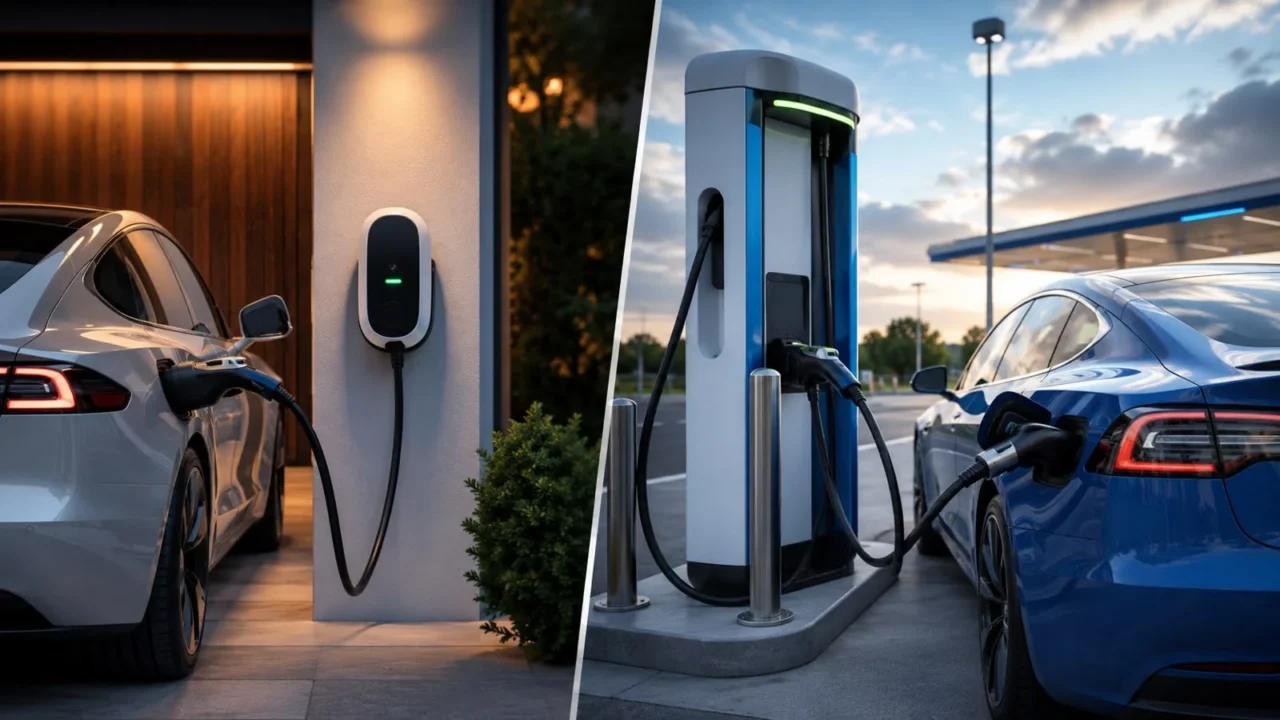
Every electric car in Pakistan can charge two ways, and the difference is not a detail. It decides what you install at home, what you look for on a long drive, and how quickly your battery ages. The short version: AC is for where you park, DC is for where you stop.
The actual difference
Batteries store direct current. The grid delivers alternating current. Something has to convert one to the other, and the only question is whether that something sits inside your car or inside the charger.
With AC charging, the conversion happens in the car, using a component called the onboard charger. That onboard charger is the real speed limit. Plug a car with a 7 kW onboard charger into a 22 kW AC wallbox and you will charge at 7 kW, because the wallbox can only hand over what the car can convert.
With DC charging, the conversion happens inside the charger, which is why DC units are the size of a wardrobe and cost what they cost. The current goes straight to the battery, bypassing the onboard charger entirely. That is how a roadside stop can add hundreds of kilometres in the time it takes to drink a cup of tea.
What this means at home
Home charging is almost always AC, and slow is fine. A car parked from 8pm to 7am has eleven hours. At 7 kW that is comfortably more than most people drive in a week.
The trap is the ordinary wall socket. A three-pin socket will charge a car, but it was never designed to carry a heavy load continuously for hours. If you intend to charge at home regularly, have an electrician assess the circuit before you rely on it. This is the most common corner cut in Pakistani EV ownership and the one with the worst failure mode.
What this means on the road
DC is what makes long-distance driving practical. It is also harder on the battery: fast charging generates heat, and heat is what degrades cells over time. Manufacturers design for it, and using DC on a road trip is entirely normal. Making it your daily habit when you have a driveway is a choice with a cost.
The other thing worth knowing is that a charger’s advertised rating is a ceiling, not a promise. Charging speed falls away as the battery fills, which is why manufacturers quote 10 to 80 per cent times rather than 0 to 100. The last fifth is always the slowest, and on a road trip it is usually not worth waiting for.
Connectors
Practically every car sold new in Pakistan uses Type 2 for AC and CCS2 for DC. Some older Chinese imports use GB/T and a handful of Japanese imports use CHAdeMO. Both are worth checking before you buy used, because a car with a connector the network does not carry is a car you will struggle to charge away from home.
Every car page here lists which connectors that model carries and what share of the mapped public network it can actually use.